Hybrid energy management
Every dispatch decision has a P&L.
A hybrid plant has more dispatch decisions per hour than an operator can answer manually — and most of them have a fuel-cost or battery-cycle consequence the operator only sees on next month's report. LumeTrax® Optimizer makes the call: when to cycle the BESS, when to start the DG, when to hold for the tariff window, when to spill PV rather than waste a cycle.
Sold as a premium module on top of Core. Deterministic dispatch where it has to be — predictive optimisation where it earns its place.
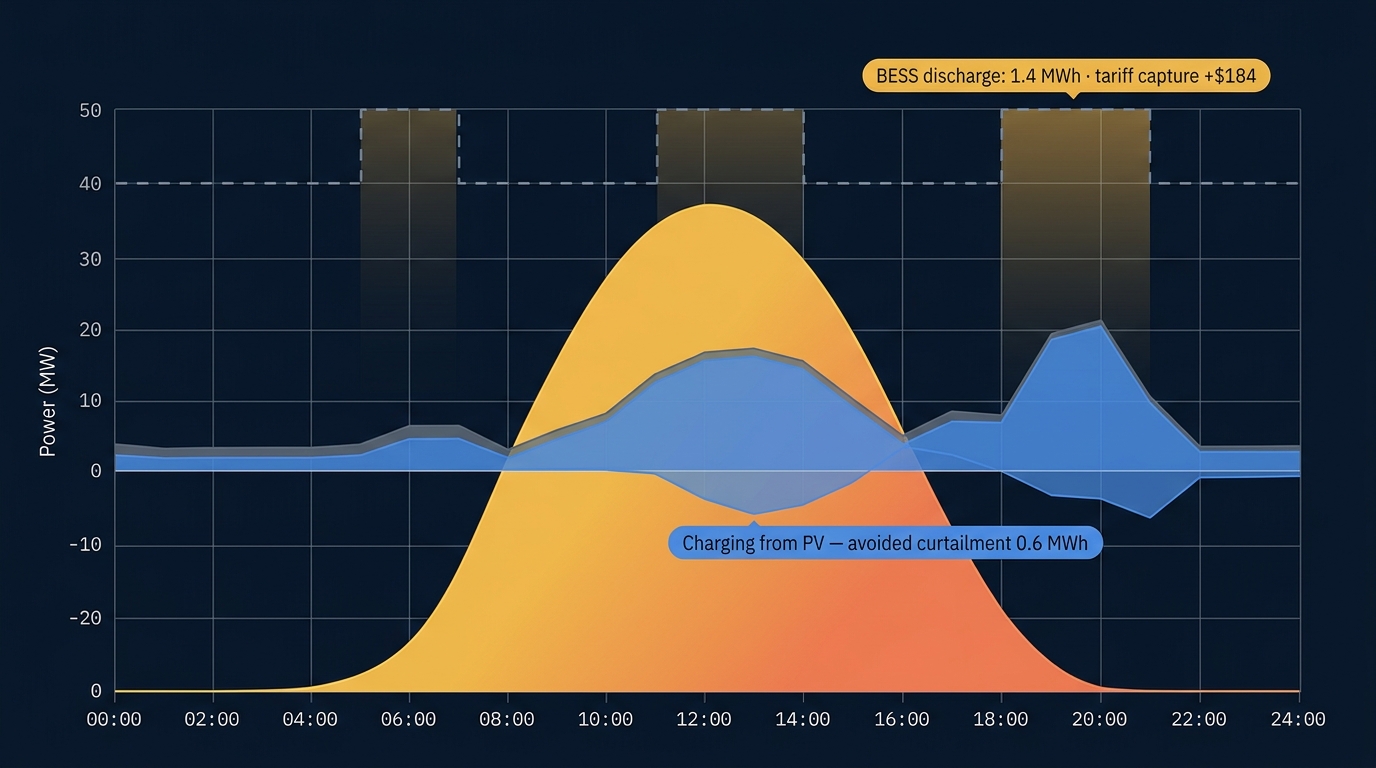
Three energy sources. Three control philosophies. One P&L that doesn't care which dispatched what.
A pure PV plant has one dispatch question: produce. A pure storage plant has two: charge and discharge. A PV + BESS + DG plant has more dispatch questions per hour than an operator can answer manually — and most of them have a fuel-cost or battery-cycle consequence the operator only sees on next month's report.
Run the BESS to absorb midday PV that would otherwise curtail. Hold the BESS for the peak-tariff window. Cycle the DG only when state-of-charge can't cover the load — but not so often that the maintenance bill eats the fuel saving. Those decisions live above the OEM controllers, against a real forecast and a real tariff. That's where Optimizer runs.
The brain that operates above the controllers
Coordinated dispatch — across PV, BESS, and DG — at the time scales each one actually responds at.
Optimizer issues setpoints to the underlying controllers — inverter active power, BESS state-of-charge targets, DG dispatch / curtailment commands — coordinated against the next-interval forecast, the current tariff regime, and the live state of the asset. Sub-second protective and safety logic stays inside the deterministic SCADA / PLC boundary, where it belongs.
The number the asset owner watches monthly
Run the diesel only when the diesel earns its place.
DG dispatch is decided against forecasted PV, BESS state-of-charge, load profile, tariff state, and the genset's own efficiency curve. The objective: minimise litres burned per kWh delivered, subject to grid-stability and reliability constraints.
Reduction in DG runtime is reported per shift, per day, per month — against a documented baseline, not a marketing claim. Hybrid plants where DG share is contractually or regulatorily capped — including microgrid configurations — get the dispatch logic that keeps them under the cap by default.
The asset that depreciates fastest if you optimise the wrong objective
Cycle when revenue justifies the cycle. Hold when degradation outruns the margin.
The cheapest dispatch policy on a single day is rarely the best dispatch policy across an asset's life. Optimizer's BESS dispatch is constrained by state-of-health-aware degradation models — depth-of-discharge bounds, temperature limits, calendar vs. cycle ageing decomposition, throughput budgets per period.
Operating cycles are scheduled where they capture the highest tariff or fuel saving per unit of degradation, not where they happen to fit a fixed schedule. The output is an asset that hits its contracted cycle life — not one that quietly accelerates its own replacement.
Where the revenue lives
Capture the tariff window. Shave the peak. Avoid the curtailment penalty.
Tariff-aware dispatch
Peak shaving
Curtailment avoidance
The premium revenue layer
Optimizer doesn't just dispatch. It stacks.
Where the market and contract structure allow it, Optimizer stacks revenue across multiple programmes simultaneously: day-ahead positioning, real-time imbalance management, and ancillary services. The dispatch decision balances the value of each programme against equipment constraints (battery throughput budget, DG runtime cap, PPA delivery obligations) so the plant captures the highest available revenue per cycle without breaching any single constraint.
| Revenue layer | What it does | Where it earns |
|---|---|---|
| Energy delivery | PPA-contracted output, tariff-window arbitrage | The base revenue layer — dispatched under PPA terms |
| Day-ahead positioning | Forward-market positioning of net plant output against day-ahead price expectations | Markets where day-ahead trading is permitted to the asset |
| Real-time balancing | Real-time imbalance correction, intra-day adjustment | Markets with real-time imbalance settlement |
| Ancillary services | Frequency response (FFR), tertiary reserves, voltage / reactive power support | Markets that procure ancillaries from BESS-equipped plants — depends on jurisdiction and grid-operator rules |
Revenue stacking is jurisdiction-dependent. Where a market doesn't permit the asset to participate in a programme, Optimizer simply doesn't dispatch into it — no marketing of revenue we can't deliver.
The reality MEA and emerging markets actually run on
Most EMS software was tuned in markets where the grid is the variable nobody worries about. Ours wasn't.
Weak-grid behaviour is treated as a first-class dispatch input — not a 'future enhancement'. Grid frequency excursions, voltage sag and swell, intermittent outages, unscheduled curtailment commands from a stressed utility — all detected, classified, and folded into the dispatch decision.
When the grid flickers, the BESS and DG keep the load served and the record keeps what happened. When the grid recovers, the dispatch returns to the cost-optimising regime. Recovery behaviour is configured per deployment — soft start sequencing, ramp-rate limits, return-to-grid coordination — so the plant doesn't trip the next neighbour when it comes back online.
Where Optimizer earns its place
Five hybrid configurations Optimizer is sized for.
| Archetype | Configuration | Optimizer's primary objective |
|---|---|---|
| Industrial-site PV + BESS + DG | Behind-the-meter hybrid serving an industrial process load with weak / intermittent grid | DG runtime ↓ · curtailment avoidance · load-following coordination |
| Utility-scale hybrid plant | PV + BESS-co-located plant exporting to grid under PPA + ancillary participation | Tariff capture · revenue stacking · BESS-life-aware cycling · PPA delivery |
| Weak-grid C&I asset | Commercial / industrial site with stable load but unreliable grid | Reliability + cost balance · DG-as-backup-not-baseload · ride-through-and-recover |
| Microgrid-constrained system | Off-grid or partially-islanded site with contractual / regulatory DG-share cap | Hard-cap enforcement · fuel minimisation under cap · BESS cycling against degradation budget |
| Solar-plus-storage tariff arbitrage | Grid-tied PV + BESS without DG, dispatched against tariff windows | BESS charge from PV · time-of-use arbitrage · curtailment avoidance |
The questionnaire confirms which archetype matches the deployment, the dispatch objectives, and the constraints (contractual, regulatory, equipment-warranty, grid-code).
Above the controllers. Below the trading desk.
Optimizer is a premium module on top of Core. It dispatches against forecasts produced in Vision and writes its own rich record back to the historian — which Vision then attributes back into loss accounting and Asset Manager turns into preventive-maintenance scheduling. Each module reinforces the others. None of them require the others — but they're more useful together than apart.
Core
SCADA & plant control
Asset Manager
O&M workflow
Vision
Performance analytics
Optimizer
Hybrid EMS — premium top layer
Pricing
Indicative starting points.
| Tier | Starting price | Suited for |
|---|---|---|
| Hybrid Control | from $2,000 / mo | Single hybrid plant. Coordinated PV + BESS + DG dispatch, tariff-aware logic, peak shaving, weak-grid handling, monthly fuel-savings report. |
| Hybrid Revenue | from $4,800 / mo | Revenue-critical hybrid plants. Full predictive optimisation, advanced battery-life-aware degradation modelling, multi-asset coordination, revenue stacking, lender-grade revenue reporting. |
| Enterprise | quotation | Portfolio scale, custom dispatch objectives, regulated environments, advanced ancillary-services participation. |
Indicative starting points only. Final pricing depends on hybrid configuration, dispatch objectives, market participation scope, and integration scope. Optimizer requires Core. Bundle pricing (Hybrid Suite, from $11,500/mo) covers Core + Asset Manager + Vision + Optimizer at a portfolio discount.
Frequently asked questions
- No. Sub-second protection, interlocks, and safety-critical logic stay inside the deterministic SCADA / PLC / RTU boundary. Optimizer dispatches intent — setpoints, schedules, and dispatch commands — at time scales the controllers can act on. This is a hard architectural rule, not a configuration choice.
- Optimizer interfaces with every major BESS, inverter, and DG controller ecosystem over the protocols those ecosystems publish (Modbus TCP, IEC 61850, OPC UA, OEM APIs). New ecosystems are added when the field needs them. The questionnaire confirms scope per asset.
- Against a documented baseline — pre-Optimizer dispatch behaviour or a contractually agreed counterfactual. Litres burned, kWh delivered, fuel cost at local price, period-over-period delta. The report is auditable to the historian record per dispatch interval.
- Yes. Shadow mode runs the optimisation but issues no setpoints — only recommendations. Used during commissioning to validate the model against real plant behaviour before authority is granted. Standard part of any new deployment.
- Optimizer fails safe to a defined fall-back regime — typically a rule-based dispatch policy stored in the on-site controller. The plant operates conservatively (no optimisation, no commercial penalty avoidance) until Optimizer recovers. Mission-critical control is unaffected because it never depended on Optimizer in the first place.
- No. Optimizer requires Core's data ingestion, alarm philosophy, and historian to operate safely. Standalone deployment isn't supported.
- Where the jurisdiction, market structure, and grid-operator rules permit the asset to participate, yes — frequency response, tertiary reserves, voltage / reactive power support are supported. Where the market doesn't permit participation, Optimizer doesn't dispatch into it. Programme eligibility is confirmed per deployment in the questionnaire.
Optimizer dispatches. Vision diagnoses. Audit & Assurance verifies.
Continue exploring.
Hybrid review