Solution
Hybrid PV + BESS + DG, dispatched correctly.
For weak grids, real fuel costs, and contractual DG-share caps. The architecture, the dispatch logic, and the lender evidence that makes a hybrid plant bankable.
LumeTrax® brings SCADA, performance analytics, O&M workflow, and hybrid EMS together so the dispatch decision, the loss explanation, and the lender report draw from one source.
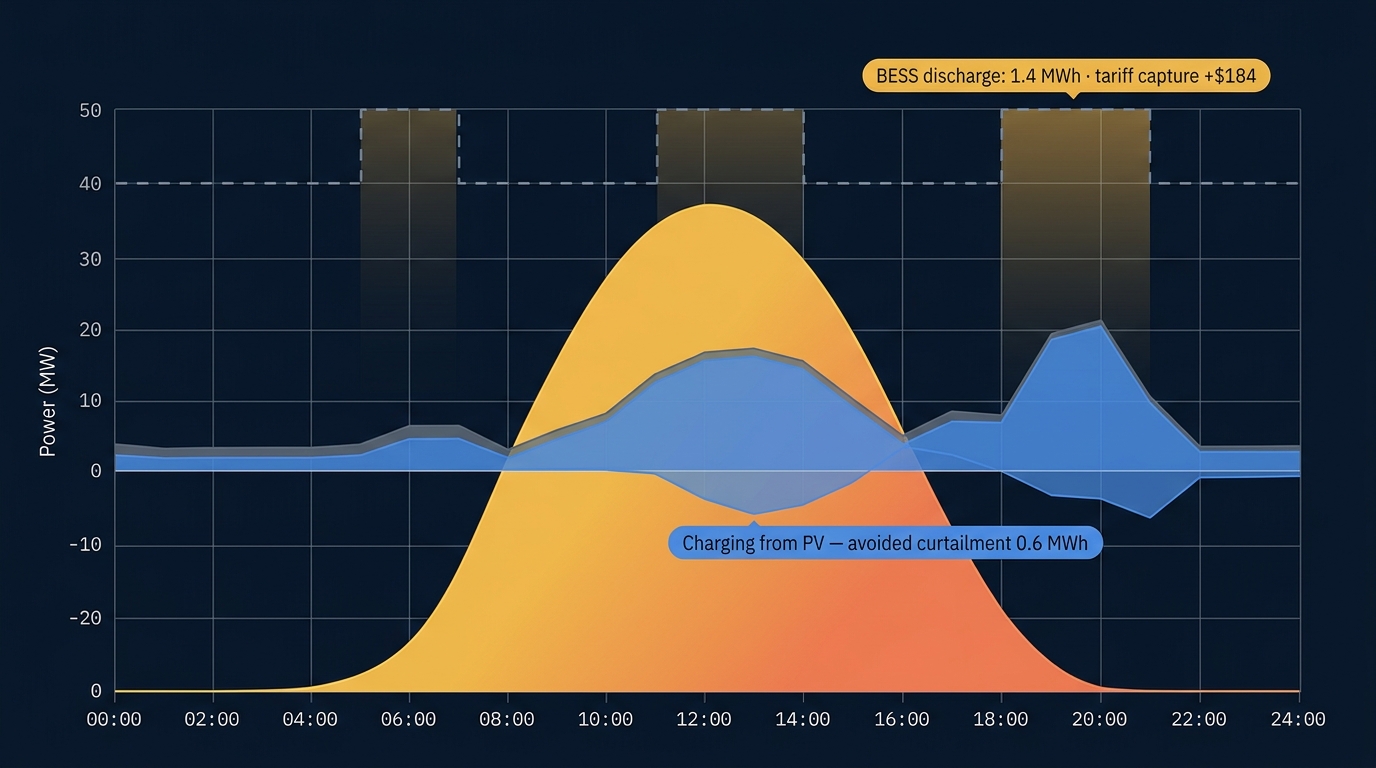
Three energy sources. Three control philosophies. One P&L.
A pure PV plant has one dispatch question: produce. A hybrid PV + BESS + DG plant has more dispatch questions per hour than an operator can answer manually — each with a fuel-cost, battery-cycle, or revenue consequence the operator only sees on next month's report.
Run the BESS to absorb midday PV that would otherwise curtail. Hold the BESS for the peak-tariff window. Cycle the DG only when the BESS state-of-charge can't cover the load. Avoid cycling the DG so often that the maintenance bill negates the fuel saving. Capture ancillary-service revenue where the market and contract permit. Stay under the contractual DG-share cap.
Generic monitoring tools weren't built for this. Most renewable-EMS platforms were tuned in markets where the grid is the variable nobody worries about. The hybrid reality — weak grids, intermittent outages, real fuel costs, regulatory DG caps, mixed-OEM equipment stacks — needs a different layer.
Where the hybrid logic actually lives
Optimizer dispatches the intent. The OT layer enforces the constraint.
Mission-critical control — protective trip, interlock enforcement, sub-second safety sequencing — stays inside the deterministic SCADA / PLC / RTU boundary. Optimizer issues setpoints (inverter active power, BESS state-of-charge targets, DG dispatch / curtailment commands) at the time scales the controllers can act on. The boundary is architectural, not promised.
Coordinated dispatch across PV, BESS, and DG, decided against the next-interval forecast.
| Module | What it contributes |
|---|---|
| Core — SCADA & plant control | Real-time visibility into every device, supervisory control gated by authority matrix, alarm philosophy that distinguishes the alarm that matters at 03:00 |
| Asset Manager — O&M workflow | Alarm-to-ticket routing, downtime classified by attribution category, SLA-tracked field execution |
| Vision — Performance analytics | Loss attribution that explains the gap between expected and actual dispatch, cohort-drift detection on degrading equipment |
| Optimizer — Hybrid EMS | The dispatch brain: DG runtime minimisation, battery-life-aware cycling, tariff-aware dispatch, revenue stacking, weak-grid logic |
Five hybrid configurations
Which one are you?
| Archetype | Configuration | Optimizer's primary objective |
|---|---|---|
| Industrial PV + BESS + DG | Behind-the-meter hybrid serving an industrial process load with weak / intermittent grid | DG runtime ↓ · curtailment avoidance · load-following coordination |
| Utility-scale hybrid plant | PV + BESS-co-located plant exporting to grid under PPA + ancillary participation | Tariff capture · revenue stacking · BESS-life-aware cycling · PPA delivery |
| Weak-grid C&I asset | C&I site with stable load but unreliable grid | Reliability + cost balance · DG-as-backup-not-baseload · ride-through |
| Microgrid-constrained system | Off-grid or partially-islanded site with DG-share cap | Hard-cap enforcement · fuel minimisation under cap · BESS cycling against degradation budget |
| Solar-plus-storage tariff arbitrage | Grid-tied PV + BESS without DG, dispatched against tariff windows | BESS charge from PV · time-of-use arbitrage · curtailment avoidance |
The Core questionnaire confirms which archetype matches the deployment, the dispatch objectives, and the constraints.
The regulatory and technical reality of 2026 hybrid auctions
When the storage ratio gets aggressive, dispatch sophistication isn't optional.
Hybrid auction structures in some jurisdictions now require BESS power capacity to scale alongside PV — Ukraine's Law No. 4777-IX (March 2026), for instance, mandates BESS power ≥ 80% of PV capacity with 2 kWh/kW duration for projects entering the PV+BESS hybrid auction category.
That ratio changes the dispatch maths: the BESS isn't a backup buffer anymore — it's a primary export asset that has to be cycled deliberately to clear its capex. Plants under those structures need:
- Dispatch logic that captures every available revenue layer (PPA delivery, day-ahead, real-time, ancillary services where permitted)
- BESS-life-aware cycling that hits the contracted cycle life — not one that quietly accelerates replacement
- Lender-grade reporting that decomposes revenue per layer per period — not a generic kWh-delivered total
Optimizer is built around these constraints. Where the regulatory regime adds further obligations (grid-code compliance, ancillary participation, hourly settlement), the Core questionnaire surfaces them per deployment.
Live deployment.
LumeTrax is running on a 14 MWp PV project in the petroleum sector, commissioned 2023. The deployment context — operating-data discipline, OT/IT boundary enforcement, lender-grade reporting — informs every hybrid plant we scope.
Hybrid review